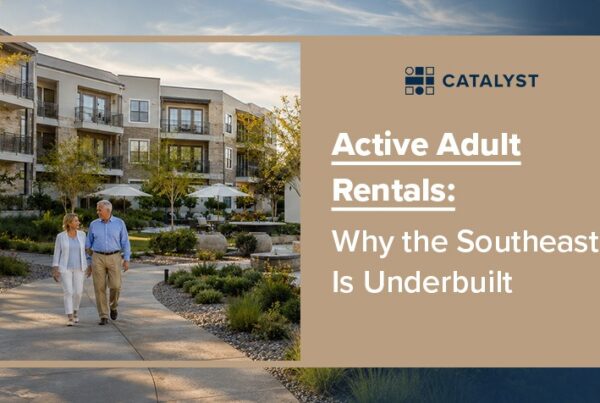
The active adult housing opportunity is often summarized with one familiar statistic: America is getting older.
That is true, but it does not fully explain the investment thesis.
The more consequential issue is that the population entering retirement age is expanding much faster than the supply of purpose-built rental communities designed for independent older adults.
The gap is especially visible in the Southeast.
Between 2020 and 2025, the South’s population age 65 and older increased by 17.5%, adding approximately 3.7 million residents. Within Southern metropolitan counties, the 65-and-older population grew even faster, rising 18.9% to more than 20.3 million people.
Meanwhile, development of active adult rental housing has slowed.
NIC MAP tracked nearly 130,000 units across 880 active adult rental communities in the second quarter of 2026. Only about 1,000 units opened during the first half of the year, well below the approximately 7,000 annual units delivered on average from 2023 through 2025. Occupancy nevertheless increased to 92.6%.
For high-net-worth investors and family offices, the opportunity is not simply that boomers need more housing.
It is that demographic demand is expanding while specialized supply remains limited, capital remains selective, and development execution is becoming more important.
Are Active Adult Rental Communities Underbuilt?
At the national level, current data indicate that active adult rental supply is expanding more slowly than its potential resident base. However, the degree of underbuilding varies significantly by market and submarket.
The active adult sector remains small relative to the number of age-qualified households it could potentially serve.
NIC MAP’s tracked inventory increased from approximately 118,000 units in early 2025 to nearly 130,000 units by the second quarter of 2026. Yet new deliveries have decelerated:
| Period |
Active Adult Supply Indicator |
| 2024 |
Approximately 8,500 units delivered |
| 2025 |
Approximately 6,800 units delivered |
| First half of 2026 |
Approximately 1,000 units delivered |
| Q2 2026 tracked inventory |
Nearly 130,000 units |
| Q2 2026 tracked communities |
880 properties |
The delivery pattern shows that development was already slowing before dropping more sharply in 2026.
Demand indicators moved in the opposite direction.
Average active adult occupancy increased from 91.2% in the first quarter of 2026 to 92.6% in the second quarter. Stabilized communities open for at least two years were 93.5% occupied.
This combination—high occupancy and slower development—supports the case for additional supply.
It does not, however, mean every metro needs another community. Market selection, pricing, lease-up assumptions, homeowner mobility and local competitive supply remain decisive.
Active Adult Supply and Demand at a Glance
| Market Indicator |
Latest Insight |
Why It Matters |
| U.S. population age 65+ |
64.6 million in 2025 |
The age-qualified population continues expanding |
| Growth in U.S. population age 65+ |
16.2% from 2020 to 2025 |
Older adults are growing much faster than the total population |
| Southern population age 65+ |
24.8 million in 2025 |
The South contains a large potential resident base |
| Growth in Southern population age 65+ |
17.5% from 2020 to 2025 |
Demographic growth is outpacing the national total |
| Growth among age 65+ in Southern metro counties |
18.9% from 2020 to 2025 |
Demand is concentrating around metropolitan growth corridors |
| Active adult rental inventory |
Nearly 130,000 units in Q2 2026 |
Purpose-built inventory remains limited |
| Active adult occupancy |
92.6% in Q2 2026 |
Existing inventory is demonstrating strong utilization |
| Stabilized active adult occupancy |
93.5% in Q2 2026 |
Mature properties continue to perform strongly |
| First-half 2026 deliveries |
Approximately 1,000 units |
New supply is arriving slowly |
| National median monthly active adult rent |
$1,945 in Q1 2026 across the 15 largest markets |
Pricing remains market-specific rather than uniformly luxury-oriented |
Sources: U.S. Census Bureau Vintage 2025 Population Estimates and NIC MAP market data.
What Is an Active Adult Rental Community?
An active adult community is generally an age-qualified, market-rate rental property designed for independent adults, commonly age 55 and older.
It is not assisted living, memory care or skilled nursing.
Residents usually do not require on-site medical care. Instead, they are choosing a residential product built around convenience, wellness, social engagement and reduced maintenance responsibilities.
Typical features may include:
- Single-level or accessible residences
- Larger apartment floor plans
- Cottage, duplex or townhome formats
- Fitness and wellness facilities
- Flexible indoor gathering areas
- Outdoor recreation
- Resident clubs and organized activities
- Lock-and-leave convenience
- Proximity to retail, healthcare and family
NIC defines the category as age-qualified, market-rate multifamily rental housing centered on lifestyle rather than meal service or healthcare.
This distinction is important for investors.
Active adult housing can retain many familiar characteristics of multifamily real estate while requiring a more specialized approach to design, leasing, programming and resident retention.
Why the Latest Demographic Data Strengthen the Southeast Thesis
The strongest case for Southeast active adult housing is not based only on retirees moving south.
It is based on multigenerational population growth.
From 2020 through 2025, the South was the only U.S. region to record population gains across every major age category. Its total population increased 6.0%, almost twice the national growth rate of 3.1%.
Within the region:
- The population age 25 to 44 increased 9.0%.
- The population age 65 and older increased 17.5%.
- Southern metropolitan counties added more than 2.7 million residents age 25 to 44.
- The same metro counties added more than 3.2 million residents age 65 and older.
That overlap matters.
Many active adult residents are not moving solely for warmer weather or lower taxes. They are moving to remain near adult children, grandchildren, healthcare providers, airports and familiar metropolitan amenities.
The growth of younger households and older adults in the same regional corridors supports what Catalyst identifies as the baby-chaser market: a location where older adults follow, join or remain close to younger family members.
This can create housing demand beyond traditional retirement markets.
A 55+ community outside Charlotte, Atlanta, Nashville, Greenville or another growing Southeast metro may serve residents who want proximity to family without sharing a household or accepting the responsibilities of owning another home.
Why Existing Housing Does Not Fully Meet Boomer Demand
The active adult resident is not necessarily choosing between two similar apartment communities.
The decision may involve three very different housing options:
- Remaining in a large single-family home that requires maintenance.
- Moving into a conventional apartment not designed around older-adult preferences.
- Renting in a purpose-built community that combines independent living with social connection and lower-maintenance housing.
This is why active adult should not be evaluated only as another apartment subtype.
The product is intended to solve a specific housing transition.
Residents may want to unlock home equity, eliminate repair responsibilities, gain flexibility, move closer to family or live in a community where social programming is already built into the resident experience.
However, the sale of an existing home can also delay that transition.
NIC observed that economic uncertainty and a stalled single-family housing market may have contributed to softer active adult occupancy in the first quarter of 2026. Occupancy subsequently rebounded by 1.4 percentage points during the second quarter.
For investors, this means the long-term demographic thesis may be durable while the timing of lease-up remains sensitive to current housing-market conditions.
Why New Supply Is Slowing
The active adult development slowdown does not necessarily indicate weak demand.
It reflects the complexity of delivering the product at a financially supportable basis.
Capital remains selective
Active adult is still an emerging segment. Lenders and equity investors have fewer comparable projects and operating histories than they have for conventional multifamily.
That can make financing more dependent on sponsor experience, local demographic evidence and conservative lease-up assumptions.
Construction costs remain challenging
Active adult residences are frequently larger than conventional apartments. Communities may also require elevators, larger amenity spaces, accessible design features and more extensive landscaping.
These features can increase development costs even though the operating model generally involves fewer services than traditional senior housing.
Lease-up requires education
The active adult consumer may not begin the search with an immediate need to move.
Sponsors must communicate why the lifestyle, convenience and community experience justify leaving an existing home. That can require earlier pre-leasing, model units, local events, referral relationships and a longer decision cycle.
At the 2026 NIC Spring Conference, industry participants identified lease-up duration as a central risk and noted that communities may need to reach approximately 35% to 40% occupancy before prospects can fully see the intended social environment operating in practice.
The product cannot simply copy conventional multifamily
Current industry experience suggests that active adult residents value modern design, larger residences and amenity spaces that encourage real interaction.
NIC’s 2026 industry discussion also noted growing interest in cottage formats and mixed communities combining apartments with cottages. The precise format, however, must reflect local rents, density, land economics and resident preferences.
What Makes the Segment Relevant to Family Offices?
Active adult rental housing may align with several objectives commonly evaluated by family offices and high-net-worth real estate investors.
Demographically visible demand
The aging of the baby boomer generation is not a speculative trend. The U.S. population age 65 and older increased by nearly nine million people from 2020 to 2025.
Potentially longer resident tenure
Active adult residents are making a lifestyle transition rather than selecting temporary housing near a job or university.
A community that successfully delivers convenience and social connection may experience less turnover than conventional apartments. However, retention depends heavily on resident experience and property operations.
Differentiated housing product
Purpose-built design and programming can reduce direct competition with conventional multifamily.
The property is not competing solely on rent, unit size and concessions. It is competing on the overall experience of living independently without the burdens associated with a larger home.
Familiar multifamily operating framework
Active adult communities generally operate without the meal programs, medical services and extensive staffing associated with independent or assisted living.
Operators still need specialized leasing and programming capabilities, but the model remains closer to multifamily than healthcare real estate.
Constrained near-term development
Only approximately 1,000 units opened during the first half of 2026, compared with an average of roughly 7,000 annually during the previous three years.
For investors able to support development through entitlement, construction and lease-up, that slowdown may create an opportunity to deliver into a less crowded future pipeline.
Why “Underbuilt” Must Be Evaluated Locally
National demographics cannot replace submarket underwriting.
Austin and Phoenix illustrate the risk of treating the entire active adult sector as uniformly undersupplied.
Although national occupancy reached 92.6% in the second quarter of 2026, Austin and Phoenix posted occupancy of 88.0% and 88.1%, respectively. NIC connected the weaker performance in those markets partly to significant recent deliveries in both active adult and conventional multifamily.
A credible supply-demand study should evaluate:
- Age-qualified households within the true resident draw area
- Growth among residents age 55, 65 and 75+
- Income, wealth and homeowner equity
- Existing active adult communities
- Planned and under-construction units
- Conventional multifamily alternatives
- Single-family home values and transaction liquidity
- Rent premiums required to support development
- Healthcare and retail access
- Proximity to adult children
- Lease-up velocity at comparable properties
- Development and replacement costs
- Entitlement risk
- Potential exit buyer demand
The question is not whether the Southeast needs more 55+ housing in aggregate.
The question is where purpose-built supply is insufficient relative to the number, financial capacity and housing preferences of local older households.
Catalyst’s Active Adult Investment Thesis
Catalyst’s active adult thesis is built around the intersection of demographics, family proximity, housing format and execution.
Target baby-chaser locations
Catalyst prioritizes markets with strong demographic characteristics and clear connections between older residents and younger family households.
The latest Census data reinforce this approach. Southern metropolitan counties are simultaneously experiencing rapid growth among residents age 25 to 44 and those age 65 and older.
This makes the active adult opportunity broader than traditional retirement migration.
It includes metropolitan and suburban locations where boomers want to live independently while remaining close to children and grandchildren.
Adapt the housing format to the submarket
Catalyst’s active adult criteria accommodate multiple formats, including traditional apartment flats, cottages, duplexes and townhomes across urban, suburban and master-planned locations.
That flexibility is important because boomer preferences are not uniform.
One submarket may support a walkable apartment community near healthcare and retail. Another may favor single-level cottages with private entrances, garages and outdoor space.
Product selection should follow the resident and the site—not a standardized national prototype.
Treat active adult as lifestyle-oriented rental housing
Catalyst views the resident as independent and active rather than care-dependent.
The objective is to create a residential environment that combines lower-maintenance living with social connection, wellness, thoughtful amenities and high-quality design.
Programming should be part of the operating plan rather than an afterthought.
Maintain basis discipline
A large demographic wave does not justify an undisciplined land purchase or aggressive rent assumptions.
Catalyst’s approach emphasizes detailed deal analysis, risk assessment and project execution. For active adult investments, that means evaluating the demand pool alongside replacement cost, achievable rents, construction feasibility, financing structure and downside scenarios.
Build where Catalyst has regional execution capability
Catalyst’s broader residential focus includes primary markets across North Carolina, South Carolina, Tennessee, Georgia and Florida. Its active adult criteria extend across Sunbelt metropolitan markets with an emphasis on strong baby-chaser demographics.
Catalyst currently lists Chorus at RiverBlue, a 153-unit 55+ community in Asheville, North Carolina, as under construction. The project represents the application of the firm’s active adult thesis within an established Southeast market.
What Family Offices Should Ask Before Allocating Capital
Is demand based on age or actual move propensity?
A large 65+ population is not enough.
Investors should understand which households are financially capable of renting, likely to move, able to sell an existing home and interested in an age-qualified lifestyle.
How much competing supply is coming?
Existing occupancy can be misleading when several new communities are under construction.
The analysis should include active adult, conventional multifamily and other age-targeted housing within the resident draw area.
Does the product justify its rent?
At the 2026 NIC Spring Conference, participants indicated that stabilized active adult properties often achieve a modest premium over comparable conventional multifamily, while cottage products can command larger premiums in certain markets. These observations are not universal and must be validated against local household economics.
Is lease-up adequately funded?
Active adult communities may require more consumer education and a longer decision process than conventional apartments.
Marketing, staffing, events and programming should be funded before opening rather than deferred until occupancy improves.
Frequently Asked Questions
Why are active adult rental communities considered underbuilt?
Active adult inventory remains small while the age-qualified population is expanding. NIC MAP tracked nearly 130,000 units in the second quarter of 2026, but only approximately 1,000 units opened during the first half of the year. Average occupancy rose to 92.6%, indicating that demand remained strong despite slower development.
Why is the Southeast attractive for active adult development?
The South’s population age 65 and older increased 17.5% between 2020 and 2025. Southern metropolitan counties experienced 18.9% growth among residents age 65 and older while also adding younger working-age households, strengthening the family-proximity and baby-chaser thesis.
How are active adult rentals different from senior living?
Active adult communities are generally age-qualified multifamily rental properties for independent residents. They emphasize lifestyle, wellness and social engagement but typically do not provide meals, assisted living, memory care or medical services.
What is the current active adult occupancy rate?
NIC MAP reported average active adult occupancy of 92.6% in the second quarter of 2026. Stabilized properties open for at least two years were 93.5% occupied.
Does high national occupancy mean every market is undersupplied?
No. Austin and Phoenix remained below the national occupancy average in the second quarter of 2026 after experiencing substantial recent supply. Active adult development must be evaluated using local demographics, competing inventory, rents, homeowner mobility and construction economics.
What are the biggest risks in active adult development?
Major risks include overestimating move-in demand, entering a market with too much planned supply, paying too much for land, assuming an unsupported rent premium, underfunding pre-leasing and failing to deliver the programming and resident experience promised during marketing.
Looking Beyond the Boomer Headline
The case for active adult rental housing is not simply that millions of baby boomers are growing older.
The more meaningful investment signal is that the South added nearly 3.7 million residents age 65 and older between 2020 and 2025 while active adult rental deliveries slowed sharply entering 2026.
At the same time, Southern metropolitan markets are attracting both older adults and the younger households they want to live near.
That combination supports demand for a housing product positioned between conventional multifamily and service-intensive senior living.
For family offices and high-net-worth investors, the opportunity lies in identifying the specific markets where demographic growth, resident wealth, family proximity, limited supply and feasible development costs converge.
Catalyst’s active adult thesis focuses on that intersection.
By targeting baby-chaser locations, adapting housing formats to local preferences, maintaining multifamily-style operations and applying disciplined development underwriting, Catalyst seeks to address a growing housing need without relying on demographics alone.
The Southeast may be underbuilding for boomers.
But the strongest opportunities will not come from building indiscriminately. They will come from delivering the right housing product, in the right submarket, at a defensible basis—and operating it as a community residents actively choose to call home.

 0
0