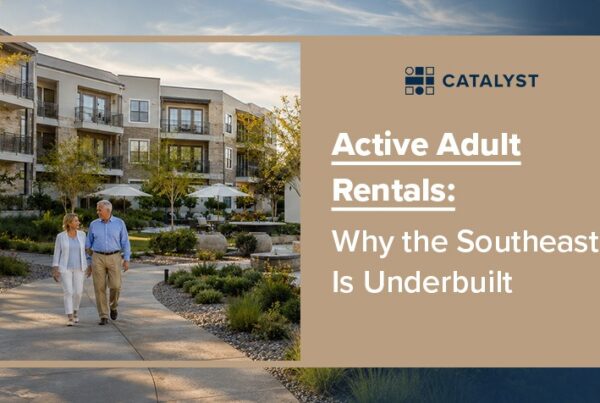
The Southeast is becoming one of the most important growth corridors for 55+ rental communities, and the reasons go far beyond retirement lifestyle marketing. This is a story about migration, affordability, housing choice, and the changing expectations of older adults who want freedom without giving up quality, convenience, or connection.
For firms like Catalyst, this trend is especially relevant. The company’s platform is already aligned with high-growth Southeast markets, with a Charlotte-based development and investment presence, a stated focus on active adult rental communities across NC, SC, TN, GA, and FL, and live projects such as Chorus at RiverBlue in Asheville, a 153-unit 55+ community. That local alignment matters because the demand story is strongest where demographic momentum and lifestyle-driven rental demand overlap.
Why the Southeast is gaining so much 55+ rental demand
The macro picture is hard to ignore. The U.S. Census Bureau reports that the South added nearly 1.8 million residents between 2023 and 2024, making it both the fastest-growing and largest-gaining region in the country. The same release shows Florida grew 2.0%, South Carolina 1.7%, and North Carolina 1.5%, all well above the national average.
That population growth is not just broad based. It is also aging. The Census Bureau says the U.S. had 55.8 million people age 65 and older in 2020, or 16.8% of the population, and the 65+ population grew 38.6% from 2010 to 2020. Even more important for future demand, the Census notes that all baby boomers will be 65+ by 2030.
In plain terms, the Southeast has two growth engines working at once: more people are moving in, and a larger share of the population is entering the life stage where age-targeted housing becomes relevant.
2025 to 2026 market snapshot
Why more older adults are choosing to rent
The old assumption was that active adult housing meant buying a home in a retirement community. That is no longer enough. According to the National Association of Home Builders, adults ages 65 to 74 are now the fastest-growing renter cohort in the country, and 65+ renters already make up more than 9% of all renters, up from 6.5% in 2013.
This shift is not just about affordability; it is about lifestyle.
Many 55+ renters want to unlock home equity, reduce maintenance responsibilities, stay close to healthcare and retail, and live in a community designed for connection rather than isolation. They are often not looking for assisted living. They are looking for independence with better design and fewer headaches.
That fits the active adult model extremely well. NAHB notes that these communities tend to deliver longer tenure, with residents staying six to nine years on average and stabilized properties seeing around 80% annual retention, compared with roughly 50% in traditional multifamily. For owners and operators, that can translate into lower turnover and more predictable operations. For residents, it means a community built around continuity, familiarity, and belonging.
The affordability case is making demand even stronger
Demand for 55+ rental communities is also being pushed by a harder reality: many older households need better housing options.
The Harvard Joint Center for Housing Studies reports that 34% of older households were cost burdened, representing more than 12.4 million households. Among older renters, the pressure is even greater: 58% were cost burdened, or 4.5 million households. On top of that, the 2025 HUD Worst Case Housing Needs report says 2.46 million older adult renter households had the worst case need.
At the same time, the broader rental market remains active. Harvard’s State of the Nation’s Housing 2025 found that renter households jumped by 848,000 in 2024, while multifamily developers completed 608,000 new units, the most in nearly four decades. Even with that supply, occupancy rose in 89% of the 150 large markets tracked by RealPage through early 2025.
The data shows that demand for rental housing continues to outpace available supply across many U.S. markets. For investors focused on the 55+ segment, this creates a compelling opportunity, as millions of older adults face affordability challenges while seeking housing options that better align with their financial needs and lifestyle preferences. Communities that combine attainable pricing, accessibility, and age-focused amenities are well positioned to benefit from these long-term demographic and market trends.
What 55+ renters want from Southeast communities
The strongest 55+ rental communities in the Southeast will not win on age restriction alone. They will win on product-market fit.
Today’s active adult renter is looking for:
- Walkable or highly convenient access to retail, healthcare, and daily services
- Low-maintenance living with modern finishes and simplified upkeep
- Social programming, clubrooms, fitness, outdoor space, and wellness features
- Thoughtful floor plans that support aging in place without feeling institutional
- Locations near family, jobs, or familiar regional networks
This is where Southeast markets have an advantage. Many metro areas and secondary growth cities across the region can still offer a blend of affordability, land availability, neighborhood scale, and lifestyle access that is much harder to deliver in expensive coastal markets.
For a developer, that creates room to position 55+ rental communities between conventional multifamily and senior care. For renters, it creates a compelling middle path: more freedom than ownership, more lifestyle than downsizing into an ordinary apartment, and more independence than traditional senior housing.
Why this matters for Catalyst
This trend sits directly inside Catalyst’s development strategy. The firm’s focus on multifamily, build-to-rent, and active adult communities in primary Southeast MSAs matches where demand is heading. Its existing footprint in Charlotte, Asheville, and Rock Hill also gives it local credibility in markets where migration, aging demographics, and rental demand are converging.
For investors, partners, and landowners watching the region, 55+ rental communities are no longer a niche side category. They are becoming a durable housing type with strong demographic support and clearer long-term relevance. In a market where many older adults want flexibility, community, and less maintenance, the active adult rental model is increasingly positioned to outperform generic products.
FAQs about 55+ rental communities in the Southeast
What are 55+ rental communities?
55+ rental communities are age-targeted communities designed for older adults who want independent living, modern amenities, and a lifestyle-oriented environment without the medical services associated with assisted living.
Why is the Southeast seeing more demand for active adult rental communities?
The Southeast is benefiting from strong in-migration, faster population growth, and aging demographics. The Census Bureau’s latest population estimates show the South remains the nation’s fastest-growing region, with Florida, South Carolina, and North Carolina among the fastest-growing states.
Are 55+ rental communities only for retirees?
No. Many residents are still working, consulting, traveling often, or living a flexible lifestyle. The appeal is less about retirement status and more about convenience, community, and maintenance-free living.
Why are more older adults renting instead of buying?
Many older adults want to reduce maintenance, preserve flexibility, stay near family, or avoid tying up capital in a home. The NAHB and Zillow’s 2026 outlook both point to growing lifestyle-driven renting behavior.
What makes a successful 55+ rental community in the Southeast?
The best communities combine the right location, accessible design, strong amenities, social programming, and a clear understanding of local demand. Markets with growth, healthcare access, and everyday convenience tend to stand out.
If you are evaluating active adult development opportunities in the Southeast or want to discuss where 55+ rental demand is headed next, connect with Catalyst. With a growing pipeline across high-demand Southeast markets and active experience in age-targeted rental housing, Catalyst is well positioned to help investors, partners, and landowners move on the right opportunities.

 0
0